I'm actually supposed to be at the Tyler (Texas) Zoo this morning with the kids, cousins, In-Laws, you name it. But the little excursion fell through, so here I am "blogging"..... about photography ..... instead of doing it!
Some photographers are like me (no, that's not my collection), as much, or more collectors. Although, I must admit that I do have a bit of a wee collection myself. I'm not here to talk about collecting which is actually a bit out of my areas of expertise, but creating a stable of cameras to shoot pictures in different situations by using different cameras that suits the purpose the best. Although it might actually seem like conspicuous consumption, my intent AND application is quite the opposite (as you'll see).
It all started here some years ago when I went "whole hog" DSLR and sold everything for a Nikon D70 and 18-200mm lens. It could just as well have been the Canon 20D, but that buying decision was completely driven by the lens. This turned out to be the correct one, since I still have it and use it as my primary lens. Some 7+ years down the road (and one VR motor replacement later), it spends most of it's time on my D300 which does our family's photographic heavy lifting.
When I say "heavy lifting"; that's exactly what I mean! Configured like this (or some version there-of ), it's a little bulky and difficult to manage for long periods of time. However, I must say that it does a fantastic job (when I do mine), and has alleviated me from employing a professional for family and children portraits over the years. Although it's no longer "state of the art", it does what I need it to do. But, what about when I don't need to do as much?
As of last year, I have the option to take; not as much camera! As you might have read in my "Compact Camera/System" series, a progression over several camera models has brought me to this option. AND over that same amount of time, I've also been accumulating lenses of a size/performance appropriate for it as well. Although a lowly 6mp by today's standards of 24 and 36mp, it's does a fine job for snap shots in package size that will fit in a winter coat pocket. It goes to places like amusement parks, and family gatherings where I neither want nor need the bigger/heavier/more capable D300.
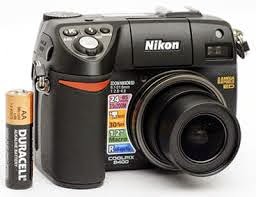
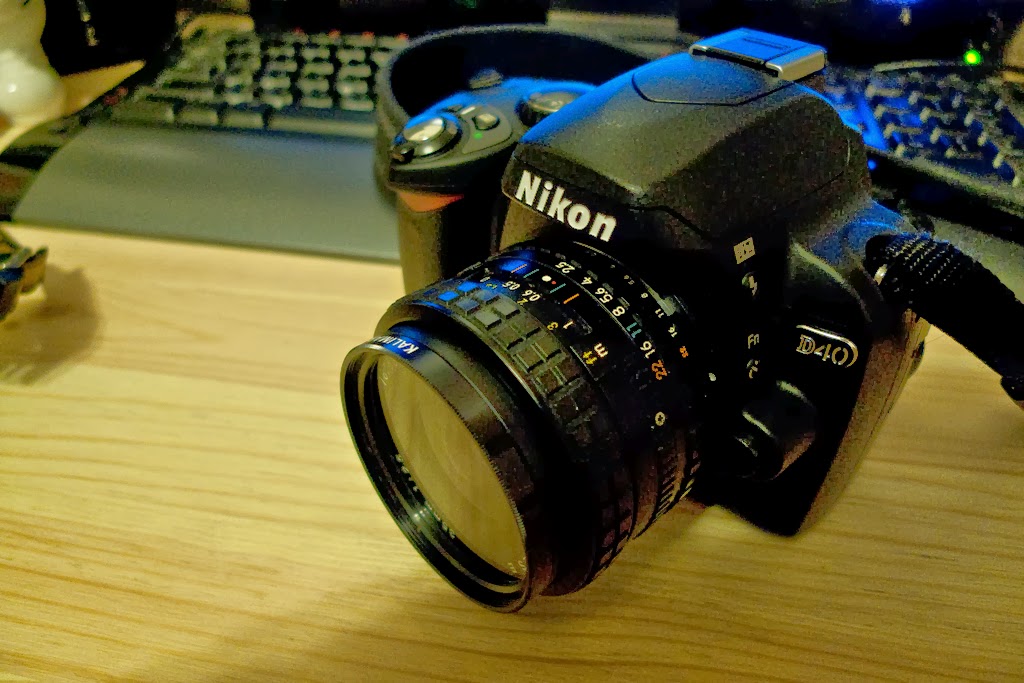
And then there's this. Given the size of the D40, does it even have a role? Well yes, it does actually. I probably wouldn't have gone out and bought it on my own, but since it arrived unbidden (along with other stuff) from my brother when he was cleaning out: I took it in like that "stray kitty". Interestingly enough; unlike it's brother Coolpix 8800 with the 35-200mm eq. lens, this 8400 with the 24-85mm eq. lens gives it the ability to do quick indoor pics unlike anything else I have! Plus lacking the pentaprism hump of an SLR and having a completely retractable lens, gives it an advantage over over the D40. Is there more?
Oh, there's LOTS more! But as part of my day to day line-up of "starters"; this is it. The Nikon CoolPix 995 of 2001!!! What on earth do I do with it? First of all, it only tops out at 3.3 megapixels, so it's not too difficult to dial down it's file to sizes to be appropriate for web use without having to fiddle with them in software. You know; pics for ads and such. Plus it's unique split body design allows me to have it twist into contortions for different angles instead of my old aching body! A couple more things. Yes, I have adapter lenses for it as well. Right now, just a wide and a fisheye, but with a 28mm accessory mount size, it's easy to find adapters for any kind of instruments like telescopes and microscopes! Another area that the twisting body design comes into play. Besides, I got mine off of Craigslist locally for about $10, then a second one showed up courtesy of my brother with the fisheye attached!
So, there they are; the "starters" on "my team" (left to right- 995, 8400, D40, D300). In fact, I employed the second 995 to shoot this picture! None were bought new. None were bought anywhere close to their original selling price. Actually, I'm not even certain that every piece of photographic equipment I own put together cost me as much as the $1800 list price of the D300 by itself! Yes: old equipment have their limitations. However, they can all be very useful if used for the right tasks. They can all be easily found out there for a ridiculously small percentage of their original selling price. They're kind of like the San Antonio Spurs of cameras!
Showing posts with label Nikon. Show all posts
Saturday, June 28, 2014
Wednesday, November 6, 2013
The "Throw-back"
God knows, that as techno-oriented as I am, I love throw-backs. Although, in the modern era, I've not been much of a professional football fan; I was always a fan of this guy....Brian Urlacher of the Chicago Bears. A modern day Dick Butkus! Maybe its a function of me getting old, or maybe its just another aspect of my weirdness, but I'm willing to embrace it.
The trend has always been strong in the photographic industry. It could be due to the engineers that still run many of these firms, or possibly that it's all a marketing ploy to get old guys like me (the more well-heeled versions) to buy these nostalgic creations. It's always been around, but it really got going a few years ago with the introduction of the Olympus Pen Micro 4/3rds camera. Clearly it's design cues were taken from the original Pen F of the '60s, but whatever the reason, it was an unequivocal success.
Of course, there were those companies who never did change their product much, even with changing over from film to digital as witnesses by the Leica M9. However, as the movement gained steam in the last few years, it's gotten too much for even the mainstream companies to ignore.
Surprisingly, the company that got this segment of the market really heated up wasn't any of the expected players. It was Fuji with the various models of the modern version of the interchangeable lens "rangefinder" idiom.
And now we have this.....the Nikon Df (f for fusion). If you are familiar with traditional Nikons, it'll be self-evident a fusion of what! A full-sized "FX" sensor from the flagship D4, focusing subsystems from the D610, and the concepts and designs of both the Nikon F3 and FM film cameras.
It's $3000 worth of ridiculously good and beautiful. I HATE it! More accurately, I hate that I can't run right out there and buy the thing! The only thing that I can do to soothe myself is to sit here with my D300 and hold it like some sort of talisman!
It's almost a perfect size. Compared to the D800 which is similar in size to the D700 which it replaced and was based on the D300 chassis, I can clearly see that it's significantly more compact. Almost an ideal "carry-around" size with full-on control knobs for it's major functions which are plainly visible. At the same time, this compact chassis is of the completely magnesium type common to professional cameras.
At the same time, when the camera is viewed from the back, it's clear that it's every bit the modern day digital SLR and all that they are capable. Yeah; I'm pretty much smitten.
The trend has always been strong in the photographic industry. It could be due to the engineers that still run many of these firms, or possibly that it's all a marketing ploy to get old guys like me (the more well-heeled versions) to buy these nostalgic creations. It's always been around, but it really got going a few years ago with the introduction of the Olympus Pen Micro 4/3rds camera. Clearly it's design cues were taken from the original Pen F of the '60s, but whatever the reason, it was an unequivocal success.
Of course, there were those companies who never did change their product much, even with changing over from film to digital as witnesses by the Leica M9. However, as the movement gained steam in the last few years, it's gotten too much for even the mainstream companies to ignore.
Surprisingly, the company that got this segment of the market really heated up wasn't any of the expected players. It was Fuji with the various models of the modern version of the interchangeable lens "rangefinder" idiom.
And now we have this.....the Nikon Df (f for fusion). If you are familiar with traditional Nikons, it'll be self-evident a fusion of what! A full-sized "FX" sensor from the flagship D4, focusing subsystems from the D610, and the concepts and designs of both the Nikon F3 and FM film cameras.
It's $3000 worth of ridiculously good and beautiful. I HATE it! More accurately, I hate that I can't run right out there and buy the thing! The only thing that I can do to soothe myself is to sit here with my D300 and hold it like some sort of talisman!
It's almost a perfect size. Compared to the D800 which is similar in size to the D700 which it replaced and was based on the D300 chassis, I can clearly see that it's significantly more compact. Almost an ideal "carry-around" size with full-on control knobs for it's major functions which are plainly visible. At the same time, this compact chassis is of the completely magnesium type common to professional cameras.
At the same time, when the camera is viewed from the back, it's clear that it's every bit the modern day digital SLR and all that they are capable. Yeah; I'm pretty much smitten.
Friday, November 1, 2013
More Pancakes Please
I hate addictions, I really do! So, repeat after me....."My name is XXXX, and I'm an addict....." For one thing, I've got NAS, no not network attached storage, although, come to think of it, I've got that too. NO! I'm referring to that weird little ailment known as "Nikon Acquisition Syndrome".....Yeah, that.....but really a sub-category of it having to do with "pancake" lenses. That's right, pancake lenses! The image is oh-so appropriate with the white gloves holding it like it's some sort of dangerous substance under clinical study!
But, price and availability isn't really the issue. As you guys know, I shoot DX sensor'd Nikons. A 45mm lens pretty much works out to be a 68mm or so eq. in 35mm terms. That's not exactly ideal for a "walk-around" camera. What I need is something that's just on the wide-side of normal. Something in the 35-40mm range. I know some folks like to go wider for that, but I like things a little tighter. And amazingly, they're on the market today! Here is the Voigtlander SL 28mm, f/2.8 which would translate to something like a 42mm on my APS-C cameras. It's manual focus, but that's OK. Remember I'm an old guy, so I focused myself for decades before I bought my first autofocus DSLR in 2009. I like this lens. It's made by Cosina, which reputedly made the "P" or latter 45mm Nikkor for Nikon back in 2001, and is now the Japanese Zeiss contractor, so yeah, they've got the "chops". They've also bought the rights to use the venerable Voigtlander name to market their own line of high-end manual focus optics. But you know what? I don't have $450-500 burning a hole in my pocket right now! So, back to the drawing boards.
And on that drawing board is this. I know, I know. The original Nikkor 45mm was only 3/4" deep, about 18mm, and the newer "P" lens was 17mm....true pancakes. This......is a whopping 24mm! But such is life. I'm sure the French have a pithier saying, but I'm a barely adequate speller in English, much less in French! So, I'm on the prowl again; this time, for a Nikon 28mm f/2.8 "E" Series lens. I've set my limit at around $50, so after I buy a Dandelion chip for it, for around $30, my plan is to be all-in at not much more than $75.
The pay-off? Here's an image of a D40 with an early version of the "E" lens mounted. Early versions were all back with the yucky looking "big-block" focusing grip. It's my intention to find the later version with the silver ring that looks like a proper Nikon lens. Yeah, it's something like 7mm longer than a "real" pancakes, and about 4 or 5mm longer than the Voigtlander, but the thing is still very compact and light.
I know that a true pancakes like this Voigtlander 40mm, f/2.0 looks much cooler, but for a $400 dollar differential, I'm going to live with it!
Here, it's depicted in it's original role attached to a 60's Nikon F, with the Photomic TN head on it. Oh, I'd love to have one of those too, but that's another story. Funny looking little thing isn't it? It's official name is the 45mm f/2.8 GN Nikkor, with the GN standing for Guide Number which was used as a coupling mechanism allowing for automatic diaphragm control in flash photography when used with compatible Nikon Speedlight units. It was small and light at 3/4" (18mm) and 5.3oz. Although I haven't been able to find out exactly, this lens is thought to be the least expensive Nikkor available in it's day. As well it should be since it's really a very simple Tessar formula of 4 elements in 3 groups.
During the later part of the 70's and early 80's, you could pick up this lens for a song, but all of a sudden, the pancake is back with a vengence! Today, all manner of small/little lenses are dubbed or claim to be the second coming of these interesting little lenses. Consequently, the price of the originals have skyrocketed despite the fact that they aren't really very useable on modern cameras. In fact, it's not really a very good idea to try and mount them (without modification) least you damage your camera! Things really got heated up when Nikon released an updated version (although optically the same) in 2001, complete with electronic contacts made to complement the FM3A. When these ended production at 25,000 (silver) and 12,000 (black), the collectors' market went crazy, driving the prices of these very useable lenses into the ridiculous (and seldom use) range. They've subsequently come down, but they aren't in the Frugal Propellerhead's radar yet. That doesn't mean, I don't want one. Look at it on the D200. That virtually turns this thing into a pocket camera.....for very big pockets, that is.But, price and availability isn't really the issue. As you guys know, I shoot DX sensor'd Nikons. A 45mm lens pretty much works out to be a 68mm or so eq. in 35mm terms. That's not exactly ideal for a "walk-around" camera. What I need is something that's just on the wide-side of normal. Something in the 35-40mm range. I know some folks like to go wider for that, but I like things a little tighter. And amazingly, they're on the market today! Here is the Voigtlander SL 28mm, f/2.8 which would translate to something like a 42mm on my APS-C cameras. It's manual focus, but that's OK. Remember I'm an old guy, so I focused myself for decades before I bought my first autofocus DSLR in 2009. I like this lens. It's made by Cosina, which reputedly made the "P" or latter 45mm Nikkor for Nikon back in 2001, and is now the Japanese Zeiss contractor, so yeah, they've got the "chops". They've also bought the rights to use the venerable Voigtlander name to market their own line of high-end manual focus optics. But you know what? I don't have $450-500 burning a hole in my pocket right now! So, back to the drawing boards.
And on that drawing board is this. I know, I know. The original Nikkor 45mm was only 3/4" deep, about 18mm, and the newer "P" lens was 17mm....true pancakes. This......is a whopping 24mm! But such is life. I'm sure the French have a pithier saying, but I'm a barely adequate speller in English, much less in French! So, I'm on the prowl again; this time, for a Nikon 28mm f/2.8 "E" Series lens. I've set my limit at around $50, so after I buy a Dandelion chip for it, for around $30, my plan is to be all-in at not much more than $75.
The pay-off? Here's an image of a D40 with an early version of the "E" lens mounted. Early versions were all back with the yucky looking "big-block" focusing grip. It's my intention to find the later version with the silver ring that looks like a proper Nikon lens. Yeah, it's something like 7mm longer than a "real" pancakes, and about 4 or 5mm longer than the Voigtlander, but the thing is still very compact and light.
I know that a true pancakes like this Voigtlander 40mm, f/2.0 looks much cooler, but for a $400 dollar differential, I'm going to live with it!
Wednesday, October 23, 2013
If Someone Will Shed A Little Light.....
You guys are probably thinking that all I've been doing lately is work on my shop and it's power tools. Actually, that's not quite the case. As I've previously discussed, my brother somewhat "out of the blue" sent me some cameras, and lens adapters. Then really out of the blue, sent me a couple of Wide-Angle/Fisheye adapters Nikon made for their fixed-lens cameras. One in particular, the FC-E9 which gives the cameras a 35mm equivalent of an 8mm Fisheye lens is really astounding! Here you see it mounted on the rather smallish CoolPix 8400, but it's really big mounted on the CP 8800! Anyway, as much fun as it's been playing with these things.... and let me tell ya, they are a HUGE hit with the 7 and 10 year old crowd, what I'm really doing is trying to get these cameras integrated into my digital photography life. So far, the 8400 with it's somewhat more compact body and 28mm (35 eq) lens is winning this little battle.
The answer is this little guy. Variously known as the Sunpak RD2000 or Quantaray XLF-50, it's small, light, and it bounces. Why not the little Nikon SB-400? Well, there is that $35-50 difference (although the Nikon is more powerful), but I also have a little secret. As most photographers are aware, Quantaray is a "house brand" of the Ritz chain of camera stores. They sell all manner of stuff using that brand, but the actual product is made by someone else, such as Sigma for many lenses, and in this case Sunpak for this flash. However, that's not the important part. It's been well publicized that Ritz isn't doing very well, and that they've gone through several rounds of store closings. What it mean is that their distribution centers often have to dump stock and these things will appear on the "secondary markets" such as eBay at a steeply discounted price. In this case, the XLF-50 can be pretty regularly bought at $50 or so. That's somewhat less than half the price of a SB-400.
I'm very OK with using a generic at that price-point!
Oh, and did I forget to mention that this flash actually bounces, vs. merely rotating the reflector like the SB-400?
Did I also forget to mention that the hotshoe foot rotates completely inside the flash body to make it that much more compact and easy to carry.... say in a pocket? No, it's not very powerful with a guide number of 20, but that's at ISO 100, which means you can pick up 2 more stops buy simply shooting at 400. On the plus side, it only takes 2 AA batteries and is quite the lightweight at 100g w/o batteries. Come to think of it; this thing is so compact, it might also make an excellent companion no only to my stable of CoolPix cameras, but to the D50 and most intriguingly the Panasonic GF-1 as well!?!
As I become more and more reliant on it as my "around-the-house" camera, one thing is very apparent. I really don't like that flash! Not only is it weak, it's also poorly located.
Of course, I could always go with this solution.... maybe not. That's Nikon's SB-600 i-TLL flash mounted on the CP8800 there. Trust me, you really don't want to see the "head-on" view of this. It ain't pretty. And with the hotshoe of the CP8400 in the corner, it would be even more ungainly on that camera. Oh, yeah.... that's the smaller of my two i-TLL flashes. It would be a LOT worse with the significantly bigger SB-800! I could go with the smaller and almost balanced SB-50 on there, but that flash doesn't take advantage of the newer i-TLL flash system that's not only baked into my DSLRs, but the 8800/8400 as well. What to do?The answer is this little guy. Variously known as the Sunpak RD2000 or Quantaray XLF-50, it's small, light, and it bounces. Why not the little Nikon SB-400? Well, there is that $35-50 difference (although the Nikon is more powerful), but I also have a little secret. As most photographers are aware, Quantaray is a "house brand" of the Ritz chain of camera stores. They sell all manner of stuff using that brand, but the actual product is made by someone else, such as Sigma for many lenses, and in this case Sunpak for this flash. However, that's not the important part. It's been well publicized that Ritz isn't doing very well, and that they've gone through several rounds of store closings. What it mean is that their distribution centers often have to dump stock and these things will appear on the "secondary markets" such as eBay at a steeply discounted price. In this case, the XLF-50 can be pretty regularly bought at $50 or so. That's somewhat less than half the price of a SB-400.
I'm very OK with using a generic at that price-point!
Oh, and did I forget to mention that this flash actually bounces, vs. merely rotating the reflector like the SB-400?
Did I also forget to mention that the hotshoe foot rotates completely inside the flash body to make it that much more compact and easy to carry.... say in a pocket? No, it's not very powerful with a guide number of 20, but that's at ISO 100, which means you can pick up 2 more stops buy simply shooting at 400. On the plus side, it only takes 2 AA batteries and is quite the lightweight at 100g w/o batteries. Come to think of it; this thing is so compact, it might also make an excellent companion no only to my stable of CoolPix cameras, but to the D50 and most intriguingly the Panasonic GF-1 as well!?!
Labels:
Coolpix 8400,
Coolpix 8800,
D50,
FC-E9,
Nikon,
Panasonic GF-1,
Quantaray XLF-50,
Sunpak RD2000
Saturday, August 10, 2013
Mana From Heaven..... or at Least San Jose
A couple of weeks ago, I came home to find this on my porch. My brother, who's going to be working for an extended period of time in Taiwan for awhile decided he needs to "clean out" before he leaves in October. I suspect, this isn't the first box I'll be getting from him. Now, as far as that weird camera goes.... if you are wondering; it's a Topcon Uni, a leaf-shuttered, interchangeable lens, SLR introduced in 1964. It came in the original leather "ever-ready" case, along with a 100mm/f4 lens as well as the standard, 53mm/f2, and other random stuff like a Topcon, waist level finder (most likely for a SuperD), and a Scheider-Kreuznach, Retina-Curtagon 35mm/f2.8 in one of those cool "bubble" containers that lenses used to be sold in...... whew! And that was just the beginning! Here's a link to a guy's blog that I read regularly, that discusses this model of camera:
http://mailch.blogspot.com/2012/02/users-review-wink-mirror-camera-topcon.html
Also in the box was this Sekonic Type L-VI selenium meter that I really like (even though it doesn't work anymore). I have a bit of an old light meter collection, so this one, which is small, fits in perfectly. You'd think that this would be enough, right?
No, not close...... next out was a Nikon 995 (my second), but this one had a FC-E8 Fisheye converter attached! That'd make the camera's built-in lens have an angle of view ranging from 8mm to 32mm as related to a 35mm camera. That's right; 8mm! I don't know where he got it, but, it's huge.... as you can see. There's a scratch on the front element, but hey, it was free.
Then out of the bottomless box, came this: a Nikon CoolPix 8800. That's right; the same model of camera I bought when I went digital "whole hog", then subsequently sold to jump into the D70 DSLR. It's an 8 megapixel "Super-zoom", where the lens goes (35mm eq.) of 35mm to 350mm.... hence SUPER ZOOM. It had the battery grip attachment as well, so it was like my original rig just came home! I had forgotten how compact it was, and I think it's really going to be nice to have as an "in addition to", camera. Yes, they are slow compared to a DSLR, and the buffer takes forever to flush when shooting in RAW, but really, when will it ever need to shoot in RAW when it sits on a shelf next to a D300!?! It'll be really great to just hand the kids when they want to go some place and need a camera.
Last, but not least, was this: the Nikon CoolPix 8400, which as the companion model to the 8800. It's 35mm equivalent zoom range was an unusual (at that time) 24mm to 85mm range. Perfect for those inside affairs like birthday parties etc. where the D300 just isn't necessary and really, just too bulky.
Both the 8800 and 8400 have the fold-out and twist screens which allow you to use it at virtually any angle. Again, perfect for informal affairs where there might be a crowd to shoot over, under, around or through!
So, what am I saying? Am I going to back-track? I'm sure most of you have figured this out already that I'm just going to add them to my arsenal, and use whatever is the most convenient and sensible at the time. We'll start off with this: as you can see, there's quite a size (and you can imagine the mass) difference between the two. This image is of the CP 8800 compared to a D70, so you can imagine the difference with the D300 which is even bigger and heavier. That part is obvious. What is not obvious is that both of the CoolPix cameras use a compact sensor.... meaning about the same size as the one your wife carries around in her purse, which has many limitations, most of which are exacerbated, not alleviated by a high mega-pixel count. So the CPs are "noisy" cameras if you try to use them at or above 400 ISO, therefore, they aren't for low light use without flash. However, they both have Nikon's advanced iTTL technology so can take advantage of my SB-600 and SB-800 Speedlights. Also, there's the "advanced amateur" bugaboo, that almost all manufacturers are prone to in that there's just not enough memory buffer to allow continuous shooting when dealing with large files (eg. RAW), so they are certainly not for fast action shooting where you might want to blow up or manipulate the image later. JPEG is the order of the day!
Are there any benefits other than weight and size? You bet! Here you see the aforementioned Speedlight compatibility at work. Yeah, it's a bit ungainly, but it works great. Then, there's the memory card compatibility. Yes Martha; that's a full-sized Compact Card in the CP 8800 there. I only have about a dozen of those things ranging in size from 128Mb to 32Gb.
Overkill? Probably. But you know; not only would I never wear a shirt like this, but these camera will keep me from carrying around a bunch of camera like this poor guy!
http://mailch.blogspot.com/2012/02/users-review-wink-mirror-camera-topcon.html
Also in the box was this Sekonic Type L-VI selenium meter that I really like (even though it doesn't work anymore). I have a bit of an old light meter collection, so this one, which is small, fits in perfectly. You'd think that this would be enough, right?
No, not close...... next out was a Nikon 995 (my second), but this one had a FC-E8 Fisheye converter attached! That'd make the camera's built-in lens have an angle of view ranging from 8mm to 32mm as related to a 35mm camera. That's right; 8mm! I don't know where he got it, but, it's huge.... as you can see. There's a scratch on the front element, but hey, it was free.
Then out of the bottomless box, came this: a Nikon CoolPix 8800. That's right; the same model of camera I bought when I went digital "whole hog", then subsequently sold to jump into the D70 DSLR. It's an 8 megapixel "Super-zoom", where the lens goes (35mm eq.) of 35mm to 350mm.... hence SUPER ZOOM. It had the battery grip attachment as well, so it was like my original rig just came home! I had forgotten how compact it was, and I think it's really going to be nice to have as an "in addition to", camera. Yes, they are slow compared to a DSLR, and the buffer takes forever to flush when shooting in RAW, but really, when will it ever need to shoot in RAW when it sits on a shelf next to a D300!?! It'll be really great to just hand the kids when they want to go some place and need a camera.
Last, but not least, was this: the Nikon CoolPix 8400, which as the companion model to the 8800. It's 35mm equivalent zoom range was an unusual (at that time) 24mm to 85mm range. Perfect for those inside affairs like birthday parties etc. where the D300 just isn't necessary and really, just too bulky.
Both the 8800 and 8400 have the fold-out and twist screens which allow you to use it at virtually any angle. Again, perfect for informal affairs where there might be a crowd to shoot over, under, around or through!
So, what am I saying? Am I going to back-track? I'm sure most of you have figured this out already that I'm just going to add them to my arsenal, and use whatever is the most convenient and sensible at the time. We'll start off with this: as you can see, there's quite a size (and you can imagine the mass) difference between the two. This image is of the CP 8800 compared to a D70, so you can imagine the difference with the D300 which is even bigger and heavier. That part is obvious. What is not obvious is that both of the CoolPix cameras use a compact sensor.... meaning about the same size as the one your wife carries around in her purse, which has many limitations, most of which are exacerbated, not alleviated by a high mega-pixel count. So the CPs are "noisy" cameras if you try to use them at or above 400 ISO, therefore, they aren't for low light use without flash. However, they both have Nikon's advanced iTTL technology so can take advantage of my SB-600 and SB-800 Speedlights. Also, there's the "advanced amateur" bugaboo, that almost all manufacturers are prone to in that there's just not enough memory buffer to allow continuous shooting when dealing with large files (eg. RAW), so they are certainly not for fast action shooting where you might want to blow up or manipulate the image later. JPEG is the order of the day!
Are there any benefits other than weight and size? You bet! Here you see the aforementioned Speedlight compatibility at work. Yeah, it's a bit ungainly, but it works great. Then, there's the memory card compatibility. Yes Martha; that's a full-sized Compact Card in the CP 8800 there. I only have about a dozen of those things ranging in size from 128Mb to 32Gb.
Overkill? Probably. But you know; not only would I never wear a shirt like this, but these camera will keep me from carrying around a bunch of camera like this poor guy!
Saturday, March 23, 2013
"From The Mind of Minolta"
Who doesn't remember that advertising slogan from the 80's and 90's? At that point, the originally created firm of Nichi-Doku Shashinki Shoten (or Japanese-German Camera Shop) was at their peak having surpassed both Canon and Nikon to become number 1 in the critical American market during this time! They were riding high. The company had been innovative for quite some time, being the first Japanese manufacturer to adopt the bayonet mount as well as full aperture through-the-lens (TTL) metering. Then in the late 70's being the first "multi-mode" SLR camera manufacturer with the XD-11 (U.S.) that is now the standard "PASM" (Program, Aperture, Shutter, Manual) modes that's seen on virtually every "advanced" camera on the market today. They were considered so advanced at the time, that it was Minolta whom Leitz turned to in the 70's when they felt the need to integrate electronics into their equipment, and the "Leica CL" was even made by Minolta in Japan. Something unheard-of at that juncture paving the road for future German-Japanese cooperative efforts such as the Sony-Zeiss, Kyocera-Zeiss/Contax, Matsushita (Panasonic)-Leitz, and Cosina-Zeiss/Voigtlander cooperative efforts seen today.
So, what happened? I'm not going to get into all the details, but let's just say that arguably the most advanced of the Japanese camera/electronics (Laser printer, copiers, etc.) companies didn't move as quickly as the other major players (Nikon, Canon) in the transition to digital photography. Even the 2003 merger with another industry major player, Konica failed to revive it and ultimately ended up with the 2006 sell-off of most of Minolta's photography assets to Sony. But we're not here to discuss the demise of Minolta, but what it means to the frugal photographer of today.
If you are a photographer of a certain age, you've probably owned a Minolta (maybe even have one sitting up in a closet somewhere). Whether it was one of the famed SR-T series or one of the market dominating Maxxums, you know that they were eminately useable pieces of equipment and top notch optics. So questions concerning the brand have nothing to do with quality.
.....which brings us to the Konica-Minolta Maxxum 7D (what a mouthful) of 2005/6. This camera was essentially a digital adaptation of the Maxxum 9i, 35mm film camera. In the world of early 2000s, it was a highly thought of "system" camera just short of the professional Nikon and Canons. What we would today call "pro-sumer" equipment. Again, I'm not going to do a review, for which I'd recommend dpreview.com, I will say that it was very well thought of at the time. There were many excellent optics available as well as other systems equipment, but the really innovative feature was the very first application of sensor-shift technology to ameliorate ever-present camera shake. Although generally considered to not be as effective as in-lense reduction as used by ,Panasonic, Canon and Nikon, it tends to be less expensive and applicable across the board on any lens attached. As such it has been commonly adopted by virtually all other makers of advanced, interchangeable lens cameras.
This camera was not only advanced, but; as the British would say, "a serious bit of kit"! Like other top level DSLRs there's a magnesium chassis, and controls to beat the band.
If you don't believe me; take a look at the back! This is what I'd imagine Batman's camera to look like (including all the rubberized control surfaces). Virtually all the contemporary reviewers of the day commented that it looked intimidating, but extraordinarily easy to learn and operate since the plethora of buttons keeps the user from having to delve into the menu system to operate it. This is pretty much the opposite from the norm for most cameras of today.
Although this camera was very advanced and the center of an elaborate and proven system it was ultimately unsuccessful in the marketplace. First of all, it was a top level prosumer camera aspiring to be the equivilent of the Nikon D200 and Canon 30D at time when those that level of equipment had moved on to 8Mp sensors. However, it's pricing (due to it's build) put it squarely in the upper range in cost of production. Really the "little brother" 5D was better positioned to be successful. Unfortunately, it's late arrival to the game also put them behind the proverbial 8-Ball since many had already bought into a "system" and therefore were not pre-disposed to switch after investing in a particular lens mount. Worse yet, by the time that this camera came to the marketplace in any numbers, it wasn't the D200 and 30D that it was competing against, but the looming introduction of the 12Mp D300 and 40D which came on the seen in first half of 2007! So, with the handwriting on the wall, and the situational of being more than one generation behind, Minolta made the inevitable decision to sell off to the only company with the resources to catch up.....Sony.
What caused all the retrospective examination of the Minolta and the Maxxum 7D? "$275 OBO", that's what! As always, I was scanning the local Craig's List ads to see if there were any good deals out there in my area. And down the in the Photography and Video section was an ad for a Minolta Maxxum and two Sigma lenses. Of the Sigma lenses (18-125, 70-300) of that generation, the less said the better, although the 18-125mm should be OK. I guess someone could use the other one until they can afford something better, the generic lenses of that type and age whether they be the original maker (Tamron, Sigma typically) or an importer such as Quantaray, aren't very good. But, back to the original thought: really, this advanced of a camera, of this build quality, with lenses so that you can use it immediately for........$275 OBO!!! I'd bet that the "OBO" means that he'll take $250. If you are the least bit concerned with the 7D's 6 megapixels, you guys know that my stance is that 6Mp is perfectly useable, especially for entry level. Remember that for our Alaska trip a few years ago, I took a 6Mp Nikon D70 and was very happy with the images it gave me (when I did my job).
A couple of last thoughts. No; it was not a "one-off" situation. I checked eBay and the mid-$200s pricing is in fact what that camera is selling for right now. Also, if you are the slightest bit concern at buying into a "dead-end" system, remember that it wasn't killed off, but taken over by Sony, so not only can you buy brand new Sony lenses, flashes etc., but even upgrade to using legendary Zeiss glass that are now made for that mount!
If I had random extra money, I'd have already snapped this thing up!
So, what happened? I'm not going to get into all the details, but let's just say that arguably the most advanced of the Japanese camera/electronics (Laser printer, copiers, etc.) companies didn't move as quickly as the other major players (Nikon, Canon) in the transition to digital photography. Even the 2003 merger with another industry major player, Konica failed to revive it and ultimately ended up with the 2006 sell-off of most of Minolta's photography assets to Sony. But we're not here to discuss the demise of Minolta, but what it means to the frugal photographer of today.
If you are a photographer of a certain age, you've probably owned a Minolta (maybe even have one sitting up in a closet somewhere). Whether it was one of the famed SR-T series or one of the market dominating Maxxums, you know that they were eminately useable pieces of equipment and top notch optics. So questions concerning the brand have nothing to do with quality.
.....which brings us to the Konica-Minolta Maxxum 7D (what a mouthful) of 2005/6. This camera was essentially a digital adaptation of the Maxxum 9i, 35mm film camera. In the world of early 2000s, it was a highly thought of "system" camera just short of the professional Nikon and Canons. What we would today call "pro-sumer" equipment. Again, I'm not going to do a review, for which I'd recommend dpreview.com, I will say that it was very well thought of at the time. There were many excellent optics available as well as other systems equipment, but the really innovative feature was the very first application of sensor-shift technology to ameliorate ever-present camera shake. Although generally considered to not be as effective as in-lense reduction as used by ,Panasonic, Canon and Nikon, it tends to be less expensive and applicable across the board on any lens attached. As such it has been commonly adopted by virtually all other makers of advanced, interchangeable lens cameras.
This camera was not only advanced, but; as the British would say, "a serious bit of kit"! Like other top level DSLRs there's a magnesium chassis, and controls to beat the band.
If you don't believe me; take a look at the back! This is what I'd imagine Batman's camera to look like (including all the rubberized control surfaces). Virtually all the contemporary reviewers of the day commented that it looked intimidating, but extraordinarily easy to learn and operate since the plethora of buttons keeps the user from having to delve into the menu system to operate it. This is pretty much the opposite from the norm for most cameras of today.
Although this camera was very advanced and the center of an elaborate and proven system it was ultimately unsuccessful in the marketplace. First of all, it was a top level prosumer camera aspiring to be the equivilent of the Nikon D200 and Canon 30D at time when those that level of equipment had moved on to 8Mp sensors. However, it's pricing (due to it's build) put it squarely in the upper range in cost of production. Really the "little brother" 5D was better positioned to be successful. Unfortunately, it's late arrival to the game also put them behind the proverbial 8-Ball since many had already bought into a "system" and therefore were not pre-disposed to switch after investing in a particular lens mount. Worse yet, by the time that this camera came to the marketplace in any numbers, it wasn't the D200 and 30D that it was competing against, but the looming introduction of the 12Mp D300 and 40D which came on the seen in first half of 2007! So, with the handwriting on the wall, and the situational of being more than one generation behind, Minolta made the inevitable decision to sell off to the only company with the resources to catch up.....Sony.
A couple of last thoughts. No; it was not a "one-off" situation. I checked eBay and the mid-$200s pricing is in fact what that camera is selling for right now. Also, if you are the slightest bit concern at buying into a "dead-end" system, remember that it wasn't killed off, but taken over by Sony, so not only can you buy brand new Sony lenses, flashes etc., but even upgrade to using legendary Zeiss glass that are now made for that mount!
If I had random extra money, I'd have already snapped this thing up!
Subscribe to:
Posts (Atom)