skip to main |
skip to sidebar
You guys remember that we moved to a new house a couple of years ago. We had wanted to be out in the country a little bit. Yup, we ended up getting exactly the house that we wanted backed up to a "greenbelt" which has a lot of big trees. Of course, when you have big trees you get the citizens there-of as well.
Happily, we have cardinals, chickadees, and we've even started seeing some hummingbirds!
However, along with the birds, we have the neighborhood bandits as well! Unfortunately, (unlike my in-laws), our household pets pay little attention to the little grey thieves. So periodically, we have a big pile of bird feed on the ground and with the fat little guys happily stuffing their cheeks. We scare them off, but in a few minutes, they're back.Unlike my father-in-law who actually lives in the country, we're inside the city limits, so no .22 rifle.....
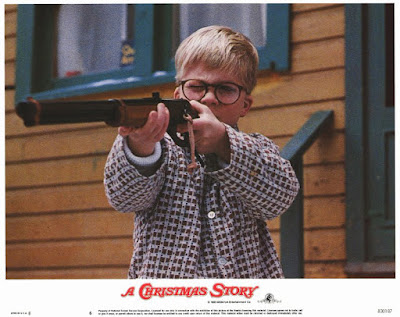
Since the dawn of time, or at least the first half of the last century, this would have been the answer! The Daisy Red Ryder BB gun, or something along those lines...... Except for one problem. See how Ralphie is holding it left-handed using his left eye to sight? Unlike most Hollywood stars, young and old, I'm right handed......, but I'm decidedly left-eye dominant! This creates a real issue in shooting. If I hold a rifle left-handed, it's very uncomfortable for me. If I hold it right-handed, I can't see a "sight-picture" well enough to hit anything, much less something the size of a squirrel! It was so bad, I had trouble doing my military qualifications when I was in ROTC. I barely qualified "Marksman" which was the lowest level there was.
Later in life, during what I'll call my "gun" stage, during which I actually owned firearms, not just studied them, I mostly bought and shot pistols. Everything from the .357 Magnum Ruger Security-Six depicted here, all the way down to the .22LR Mark II automatic. And if I do say so myself, I was pretty darned good with them. Quite a bit better than average, even when shooting the powerful .44 Magnum. Then I started my career in Higher Education administration which entailed that I live "on campus" for a number of years and my gun days came to a screeching halt. I sold my guns and for the next 20 or so years of my life, I only peripherally paid attention to firearms. But I still loved them deep down inside.
Then, this happened. Let me discuss the parameters of our situation. There are squirrels; lots of them in our area. They are classified as "varmints" (like mice) here in Texas and can pretty much be dealt with any way legally necessary. Which of course, here in town means NOT discharging a firearm! The use of BB and/or pellet guns are legal though. For my own satisfaction, the rather thick woods and underbrush behind our house makes the use of a pellet gun pretty darned safe. Now, on to what I ended up choosing to use.

The Walther PPQ.
No, not the actual Walther PPQ, but the Walther licensed Umarex built in Taiwan, CO2 "air pistol".
Yup, it's a very close copy of the "real steel" 9mm Parabellum firing pistol, which of course if part of the attraction. No it is not the whole story, so let me explain what-all went into the decision making process. These things are in the lower part of the airgun world. The FPS (feet per second) of a fired pellet is somewhere south of 400, which makes them adequate for squirrel out to maybe 30 feet. Coincidentally, that's about the size of my backyard. So that part works out. I wanted something that could fire off several shots one after another, so CO2 vs. pump. Since I wanted it to be lethal on the little critters, it needed to fire pellets. And I wanted to practice cheaply with BBs, that limited my list of candidates quite a bit. What did I want?

No, not Pierce Brosnan,...... the Walther P99 that the Brosnan-Bond typically used. I love that pistol and Umarex makes a very nice pellet gun copy, but it's about $170. This is where working with the (a) wife comes into play. The Umarex Walther CP99 is a really nice copy of the compact version of the P99, but it's a more complex gun as well. Since this is the first time that during my time with my spouse that I've had a gun of any kind; I decided that spending less money was a better way to go. Especially, since the PPQ could be had for $50 or roughly a third of what the CP99 price. But, if I'm a Bond fan, what about the classic Bond Walther?

The PPK? Umarex actually makes one of these as well. This is where practicality meets fun. Unfortunately, the PPK is a BB only, so pretty much unless on our invading squirrels. Will I probably buy one, one day just for fun? Sure, along with the CP99 as well. So, this is where Bond movie fan, meets squirrel fighting home-owner, meets the practical husband.
It's ironic that around my building, I've been hung with the reputation of being a "Fine Arts" hater. This isn't my platform to debunk that particular myth, but I'll simply say that I'd bet that there aren't many (if any) teachers at my school (including band, and drama) who are as involved in the hobby of music reproduction as I am. Why is this, and why should you care?
I'll start by saying that I, like everyone else am a product of my environment. My father, loved music and it was played in our home most nights. It was our electronic hearth. There was no TV, no Internet, no Smartphones...... heck, the real phone rarely rang in the evenings. So, our console system very much like the one above was what we gathered around.
Ours was built around the Telefunken Operette receiver. It was a fine piece of German engineering and at the time in the early to mid-60s, it was considered "cutting edge"...... it was STEREO!!! Those years, having stereo was the next "new thing" after Hi-Fi (or High Fidelity). My father being an Engineer by profession was pretty serious about his equipment. So, within this environment, I grew up.
But it wasn't just they equipment though, Listening to music connects to us like no other activity. It has to ability to transport us to another place and time, complete with virtually all the sensory aspects fully intact. Like being transported in a time capsule. On the other end of the continuum, it can encapsulate a place, time and feelings in a way that nothing else I can think of.
To this day, I can't listen to anything from the Styx Grand Illusion album without being immediately teleported to a car in my Senior year of high school, going somewhere with the 3 guys I went with everywhere.
Whereas the Supertramp Breakfast In America album immediately takes me to Waco, Texas and a different group of people at a different time! It's in there; inextricably hooked into our brains for the rest of our lives. It works with everyone. Just a different piece of music.
These connection are what makes audio/music very different than my other hobbies of photography or computers, just different. I'm not getting into those today because they'll have their time. For me, audio has almost come full circle.
For a time, that hardware, was replaced by this hardware! The years when those of us who chose family make everything else secondary. However, as I approach that time when the kids are old enough to not require constant attention AND importantly, they close to the age where they appreciate what fine audio (and video) equipment can do; I'm starting to get back "in the game".
No, not in the old, I'm out of college, I'm single and my desires are the most important idiom. Those days and that level of hearing are long gone! Plus, the college years are still looming for my children. No, this is the much older, and hopefully wiser and more circumspect me.
No; more along these "bang for the buck" separates, although some will argue that there's no such thing. Next time, we'll discuss what I have, what I'd like for that to eventually turn into and how I'm planning on getting there.
You could call the late 90's of my audio history; the Yamaha Era. By that time, I had gone through several epochs (which you're aware of, if you've had the patience to following along). The previous one with the a/d/s/ gear and cobbled together A/V parts as my "collecting years". You could say that I was getting tired of the hassle of various external processors, several amps, and a table covered with remotes! By this point, I had figured out that I liked Yamaha's approach to surround. Let me go off in that direction for a little while just to reminisce if nothing else.


In 1986, Yamaha brought Soundfield DSP to market in the United States in the form DSP-1. It was an add-on processor like everyone else at that time. However, their technology was different. Everyone had a chip that simulated different venues by adding delay into the channels for the effects (surround/rear) channels, plus some level of attenuation, you get what could be called an "echo". Every room, unless intentionally treated has some sort of an echo signature. We tend not to notice unless it's pronounced such as the case of a cavern or other large space. Which is why the building of concert halls was/is part science and part art. Virtually all manufactures programmed the "echo" or delay into their chip based on the math of sound reflection/refraction of venues large (concert halls, stadiums) and small (jazz clubs, studios) and called it good. They pretty much sounded alike and really, not that great to my ear. What Yamaha did wasn't like anyone else. They went to specific venues all over the world and recorded the sound characteristics using an array of microphones, then programmed the specific digital signature into a chip to be called up by the name of the venue. I liked theirs much better. In those early years, I couldn't come close to affording their processors, but as with anything digital, the technology got cheaper and more powerful very quickly. So, when I got ready to pare down the number of components I was using in my system. Their new flagship product, the DSP-A1 was high on my list. It is to this day, one of the few components that I've ever bought new and at the 1998 MSRP of $2600, the most expensive by a fairly wide margin.

One of my weirdnesses, is that I generally like the majority of my component to match (if the sonic differences aren't significant). I like for things like the operational designs to be similar, such as the power button being on the same side and type, the markings to be alike, etc. So, I chased down Yamaha's top-of-the-line turntable, the PF-800 (which was very, very good), and other components of that era, such as a CD Changer, Cassette Deck.....
and one of the very best Minidisc Decks of the time, the Yamaha MDX-793. I was into Minidiscs for my portable media in those days.
On the video side of things, along with a procession of their TVs, I liked (still do) Sony products. Those were the Laserdisc years, so I progress through a few of the Sony models of those as well. At that time, I had also finally given up on SuperBeta and moved to SVHS as well, ultimately owning a SLV-R1000 which was an amazing product, along with a really nice SLV-585HF for regular VHS as well.
I was still using the a/d/s/ L1290 as my mains but added a Snell KIIv as the center channel after finding it to have the closest sonic characteristics to my mains. I was using a pair of Paradigm ADP-350s as the surrounds which were very good as well. The "front effects" (a concept that Yamaha was using at the time with their "Soundfield" system was a pair of a/d/s/ L200s. These had a very similar driver compliment to the upper range of the L1290s, so did a great job of not calling attention to themselves.
So, this was the state of my system from the late 90's till we moved to the Dallas area around 2003. That gear went from Lubbock, Texas to Chicago, Illinois, back to Lubbock! It was really nice equipment and sounded great! Those were happy years.... until I dismantled it and sold of fthe major pieces to help fund our move to Dallas....... but that's a different story.
Let me take a break on my audio system series and discuss something else while it's on my mind. The college student computer, since I'm working on this for a client.
Before this even happens, there's a lot to be done in the summer before your kid leaves. There's a ridiculous amount of stuff to buy ranging from the almost insignificant to the really important. In today's world, one of the most important is their computing device(s).

When they think of college, one of the first things that flashes into a parent's mind is this...... a tiny space where two people have to live, keep all their stuff and co-exist..... not necessarily in that order. I know, they may not all be this tight, but this is certainly not the smallest! Believe me, I know! In a former life, I've worked as a residence hall director/coordinator for some few years. I'm all too familiar with these rooms. I'm not even going to reference my days as a college student at Texas A&M University, because we didn't bring electronics (I was in the Corps of Cadets), and personal (versus PCs) computers for students pretty much didn't exist in 1980.
So, the next thing that jumps into a parent's mind is this..... How is he/she going to get all that stuff into his/her room, so the natural inclination is to go with......
..... and that'd be a mistake..... for the following reason(s). Not all students are alike and not all computers have the same capabilities. If your kid is an English/Psychology/Education/Nursing/Family Studies (the list goes on), then you're good. You can stop reading right here, and buy whatever the school is recommending (with one caveat) and mark that item off your list. There is one other little thing, but I'll address it later. However, if your pride and joy is aspiring to be an Engineering/Graphics Design/Animation (anything that's computing intensive), things get complicated.
This is what I'm recommending (in general), with a few modifications. Why, two computers for "Pete's Sake"!?!

Do you remember that old "college feel" that you were so impress with when you visited? The ivy covered walls, the quaint, late-1800s/early-1900s buildings, or even those big modern looking buildings that held the huge lecture halls that look like this? Go ahead, tell me what you see? Remember, falling asleep in the back of those like I did and knocking your spiral notebook onto the floor making everybody look at you? Imagine that spiral being a $1000 laptop notebook the size of a small briefcase. I'm sure you can image that off of those little tiny fold-up lap-desks right? Then imagine your kid throwing his (it's always the male isn't it) computer into his bag, then throwing that same bag down.... how many times over the course of just one week? The bigger/heavier the computer, the more mass and the great the impact. That's just one factor.

OK, now imagine your kid schlepping that same computer across this campus from class-to-class every day. You remember, the same one that you struggled to walk across when you guys visited?
Then imagine the laptop in his/her bag being one like this (the Dell Precision M8400 which was one of the top 5 best engineering laptops of it's year), roughly 8 pounds without the giant 1-2 pound power adapter, but that they'd have to carry because the "real world" battery life will be between 1 and 2 hours....... "silence" as the commercial says. Yup. Oh, but they could leave that one in their room and use their phone like they do all the time now, right!?! OK. Chew on this. On a regular basis today, profs will refer to documents that they've prepared and that students must reference (often in class), or a website, or last week's notes on a PowerPoint that he/she's not putting up because they have today's up there on the projector that you're already struggling to see because you're sitting 120 feet away in that giant lecture hall. So yeah, suffice to say that they need to be carrying a device that they can use all the time to access data at will.


In today's world, the there are three candidates for this job. A "convertible" computer such as Microsoft's Surface/Pro, basically a full UltraBook PC in a tablet form that the user can easily attach a keyboard for productivity use. The tablet, in iOS, Android or MS Windows that can do similar stuff, not quite as capable, but can be cheaper/lighter and in an amazing variety of sizes, prices and forms. And the "Clamshell" "Ultra-portable" (at or sub-3lbs) full laptop. These are typically around 12" screens making them OK to carry and use in the classroom. So, that's one computing device. The other?

That's a desktop PC? Yup. This one is the Cooler Master Elite 130 case, less than $50 to buy, about the size of the proverbial breadbox. Don't like the style, buy any number of those ones between $50 and $100, a Mini-ITX motherboard, other parts, build (or have somebody else build) a machine that's going to cost around $600. Spend another $400 to $600 on the other device, and you're done! There is one more option if you have $3000+!
This is an Asus, but Razer started it a year of so ago. What is it? It's an UltraBook, with built-in graphics (read, not good for heavy duty use), but connects to an external enclosure that houses a full-sized graphics card of your choice and therefore giving the notebook PC the muscle to do pretty much anything. Plan on spending around $4000 total to get yourself going. My plan proposes spending $1000. That's the price of a pretty nice laptop computer at Best Buy. There'll be more parts to this concept to come.
If you're of a certain age, you'll probably recognize these audio components. It was the 80's and in the audio world, everything was big..... even when it wasn't. These guys were the Porsche of the audio marketplace. Refined, stylish, and expensive (virtually all the components were within shouting distance of $1000, 1980's dollars). By the time, I came across a mint R4 receiver in the mid-90s, they were in the last years of producing home audio, having put their eggs into the car audio basket. I know, it's bit of a sad tale. But this isn't a requiem about Analog and Digital Systems (otherwise known as a/d/s/), but of how my audio path led through this iconic company and their unique equipment.
In my previous post, I had discussed how I went down the primrose path of sonic detail and ended up with a rather harsh sounding system. In order to correct that mistake, I sold off the Bowers and Wilkins DM550s and bought another darling of that era; a pair of NHT 1.3 speakers.
.....
No; those aren't NHT 1.3s, they are Acoustic Research AR-3a speakers (of which I would own a pair). ??? Let me wax historically, in an audio sense anyway. Back in the 60s and 70s when American companies dominated the market, there emerged two camps; East Coast and West Coast (the "Bird" vs. "Magic" of audio). To pare it down to the essentials, it was more bass (West Coast), vs. accurate bass (East Coast). On one side, you had JBL, Cerwin Vega, etc and on the other, you had Advent, Acoustic Research (AR), KLH which eventually begat Boston Acoustics, a/d/s/, NHT..... you get the idea. And based on what I've just told you, you can see that I was an East Coast guy. East Coast speakers tended to use "sealed" enclosures, otherwise know as acoustic suspension, generally using soft-dome tweeters. To my ear (note that emphasis, since I'm not into telling anyone else what they should be hearing), they sounded faster and tighter, whereas the West Coast designs sounded brash and in-your-face. And after my experience of the high-end in-your-face with the badly match Adcom amp and DM550s, I didn't want any of that. Thus started my "dark" time. I don't mean dark as in "Dark Ages" or anything like that. In the audio world, "dark" means the opposite of "bright". If you've ever experienced that end of the spectrum with overly detailed highs, you know what I'm talking about. Certain models of certain brands (seamed to be predominantly British) such as Celestian, lower-end B&W and KEF tended in that direction.

This led to quite a few years with speakers such as the NHT 1.3a and back to my original thought a few different a/d/s/ models culminating in a pair of L1290s that I bought in bad cosmetic condition. I spent well over a week taking them apart and refinishing the veneer while waiting for my job with Tulane University to come through, then they went with me to New Orleans and all through the various jobs during my 10 year odyssey in higher education administration.
During those 10 years, I went through a rather interesting phase of my audio life. I call it the "Atelier Period". So, we've come full circle back to where I started today. It might be a little weird, but I have a bit of interior designer in me, and when you're unmarried and able to indulge your audio as well as design whims, it can "become a thing". It was completely impractical and really didn't sound as great as it should have given the cost, but hey..... it was cool.


Let me start with a quick primer on a/d/s/ from what I know about it. They were the speaker design arm (based in New England) of German electronics giant Braun (yes, the coffee maker brand) which by the 80s had bought themselves loose. During those years, they had an agreement with Braun to collaboratively design and sell the electronic components of the line in the U.S. under their own brand while it was sold in Europe as Braun. These were extremely high-end pieces, but in the "go-go" era of the mid-to-late 80s they sold well enough. Think of it was the German alternative to (and better sounding IMHO) B&O gear. It all started with a random R4 receiver that I came across at the store I hung out at. So I bought it. Now; it's kind of dumb to just have one piece of a/d/s/ gear. They aren't shaped or sized like anything else and as you might have noticed, they are made to work together electronically as well as design-wise. Before I knew it, I had the CD3 (CD Player), C2/3 (Cassette Deck), P4 (Turntable) and PA4 (Amp). Ultimately, I would have another set of the gear in my bedroom as well. It was cool looking and sounded pretty good, but let me tell ya.... it was a giant pain in the behind to tote around as I move from university job to university job all over the country. On top of that, in order to adapt it to A/V which was becoming a thing at that time, I had to add surround processor(s), additional amps, subwoofers, racks.... the list goes on. Sometimes I felt like I moved more A/V gear than other stuff!

..... and right around that time..... this happened! It's really not what you think. My new bride didn't put her foot down. I simply got tired of the pain in the neck my cobbled together A/V system was getting to be as it progressively become more "V" and less "A". It simply wasn't worth it. Plus, it wasn't as if it was audio nirvana anyway. So, my days as an a/d/s/ collector-user came to an end as the various pieces got sold off to be replaced by a system built around the Yamaha DSP-A1. I still kept my L1290s as well as some other a/d/s/ speakers such as some L200s and L300s for some time, but the days of beings more collector than user was coming to an end. Thus end'th my "Teutonic Era". I'm sure you can guess what the next post is going to be about.


